We started simplifying trig expressions this week in precalc. This is only my favorite stuff all year. I know it starts out difficult for many of the kids (especially because they're just learning their identities) but after a couple of days in I've been really happy with the discussion I've heard. They work SO WELL in their groups that I'm ticked I didn't do this last year. And a few of the kids have even admitted to me that they kinda like these kinds of problems!
(When we went over the first assignment, I asked the class what we should do for a particular problem. At the exact same time, two girls said, "Cry." I had to admit it was pretty funny.)
I think some of the kids get frustrated with simplifying because they see that it's so easy for me, so the first day I tell them why. Aside from the fact that I think these types of problems are fun, I also have spent two weeks a year, three times a day, for the last 15 years working these problems. I would hope they'd be easy!
Today one of the kids decided I needed a challenge so he found a problem online to give me. Here it is:
I admit to having no clue where to begin. I thought about power-reducing formulas and half-angle formulas and got nowhere. Then I tweeted the problem and got some help from a bunch of people who decided that it wasn't actually an identity. After tweeting at the student, he gave me the link to the problem where I discovered that you're given that a + b + c = 180. So that changes things. (I'll use that as my excuse tomorrow). But many thanks to Steve, Glenn, Marshall, Nik, Matt, and David for trying to help a girl out!
It led me to an idea, though. I'm thinking maybe I'll have the precalc kids come up with what they think is a tough identity to simplify and see if they can stump me. I tried something like it last year and got some good results, but I didn't incorporate the "Stump the Teacher" challenge. We'll see.
The best moment of the day came in my general Algebra 1 course 7th period. There's a girl in there who is from Cambodia, and she's honestly amazing. She knew very very very little English when she started in August, but her math skills were (luckily) great and she did awesome. She's the perfect student: she does her homework every night (and usually does extra problems), she is always concerned about why she gets a problem wrong, and she is able to laugh at herself when she does something silly. (Actually, it's usually an "Oh my goodness!" reaction.) But today she walked into class as I was talking to the special ed teacher who's in here with me. The girl said something to me that I didn't catch, so I asked her to repeat it. Her comment? "Mrs. Fouss, you look beautiful today!" Oh my gosh, how sweet!
(This is what she did for our last homework problem today... think anyone else in this class would've had an inkling of what she was doing?! I felt bad because it was just "read the graph" problem and she went way beyond. That would certainly be a language issue.)
Showing posts with label trig. Show all posts
Thursday, January 17, 2013
Tuesday, December 11, 2012
Precalc Scheduling Stuff
Feel free to move on in your reader... I'm just working through some issues I've been having with what to do in precalc for the next 8 days.
The stuff in pink is what I'd had planned to finish up with in precalc. We've been working through chapter 4 for AGES (since Halloween, I'd guess) and are finally finishing it up. I don't usually test over the whole chapter because it's been so long and choppy (Thanksgiving's in there) and I've done a bunch of quizzes in the meantime.
The problem is that I either have too much time or too little.
1. I can finish up with Chapter 4 stuff this week but that leaves me 5 days with nothing (and I'm not starting exam review that early).
2. If I start something new (like solving triangles using law of sines/cosines) then I don't have enough time to do all that I want to do with it.
3. Those last two days before break (the 20th and 21st) we have holiday assemblies which affect 2 of my 3 precalc classes and Grandparent's Day (which will probably affect 2 of my classes also). That's why I'm choosing not to follow the schedule I have planned.
Now I'm thinking maybe I could skip Inverse Trig Functions (for now), which is 4.7 and go straight to the solving triangles bit, which could take at minimum 5 days. That would get me through the middle of next week and then leave a couple of days for kids who are here to start exam review.
Or review factoring, which they stink at.
Hmm. An option.
The stuff in pink is what I'd had planned to finish up with in precalc. We've been working through chapter 4 for AGES (since Halloween, I'd guess) and are finally finishing it up. I don't usually test over the whole chapter because it's been so long and choppy (Thanksgiving's in there) and I've done a bunch of quizzes in the meantime.
The problem is that I either have too much time or too little.
1. I can finish up with Chapter 4 stuff this week but that leaves me 5 days with nothing (and I'm not starting exam review that early).
2. If I start something new (like solving triangles using law of sines/cosines) then I don't have enough time to do all that I want to do with it.
3. Those last two days before break (the 20th and 21st) we have holiday assemblies which affect 2 of my 3 precalc classes and Grandparent's Day (which will probably affect 2 of my classes also). That's why I'm choosing not to follow the schedule I have planned.
Now I'm thinking maybe I could skip Inverse Trig Functions (for now), which is 4.7 and go straight to the solving triangles bit, which could take at minimum 5 days. That would get me through the middle of next week and then leave a couple of days for kids who are here to start exam review.
Or review factoring, which they stink at.
Hmm. An option.
Monday, December 3, 2012
Finishing Up Sine and Cosine Graphs
So last week we started graphing sine and cosine in class.
Day 1: Filled out a chart of values, noticed things, used Desmos to see what different transformations did. (I wrote about it here.)
Day 2: Whiteboards... such a nice easy to way to see who "gets" it!
Day 3: The kids picked up this picture (after taking a short weekly Algebra review quiz):
Day 1: Filled out a chart of values, noticed things, used Desmos to see what different transformations did. (I wrote about it here.)
Day 2: Whiteboards... such a nice easy to way to see who "gets" it!
Day 3: The kids picked up this picture (after taking a short weekly Algebra review quiz):
I found this in a Sports Illustrated almost two years ago and kept it (and was actually able to find it last week when I wanted to! That's a miracle in itself.). On the board, I wrote: "If Jay Cutler's maximum was 100% and minimum was 0%, write an equation that models his week." I'm sure I could've come up with a much better lead but I was stumped... if you have any ideas please let me know! It was a more interesting way of picking out the transformations and putting them together to write an equation than a randomly generated graph would've been.
We decided to use cosine with an amplitude of 50, vertical shift of 50, period of 6 days (I gave them dates for those maximum values that were 6 days apart) and applied a horizontal shift of 0. But after writing that equation, I told them that, Oops - the graph actually starts with that first point which was two days before the maximum. So then we had to incorporate that horizontal shift.
It was pretty fun (I thought). Then I gave them an assignment to write equations for 4 graphs on their own.
Day 4: (Today) So now we're applying their equation writing skills. I put together a list of 10 different cities' average normal maximum temperatures (found on noaa.gov). They have to plot these values on a grid and come up with an equation that models that city. They also have to do it for Cincinnati so that we can compare the two.
Day 5: (Tomorrow) We're going to use my new bff Desmos to check people's models. I'm going to have them plot the data points and enter the equation that was generated by their classmate. Then I think I'll have them set up an equation with sliders (all you do is enter something like a cos (bx + c) + d and you'll be given the option to set up sliders) to have them try and fit an equation. Or something like that.... I'm still trying to refine my ideas.
So what's up for Wednesday? Tangent and reciprocal graphs.
Wednesday, November 28, 2012
What do you notice?
Today in Precalc we started graphing sine and cosine curves. I gave them these charts to fill out all of the sine, cosine, and tangent values of our favorite unit circle angles. Then I handed out
Then I asked...
What do you notice?
It was fun to hear their observations. They started out a little slow (I don't think they're ever asked anything like this without there being a "right" answer) but after a few non-mathy things they jumped into odd/even, zeros, and maxima.
This was an easy segue into the "correct" terminology of amplitude and period, and the transformations followed from there.
Oh, and it was soooo nice to have the kids make a prediction on what a value would do to the graph (like a vertical translation) and then show it using the Desmos calculator. Love their sliders!
Monday, November 12, 2012
#Made4Math: Trig Stuff
We're at the point in Precalc where I'm going to start expecting the kids to *know* the values on the unit circle. Some of them won't put in any more time than we do in class (and it'll show) but many of them will spend some time learning those crazy ordered pairs.
I have a few things that I give them to help out a bit.
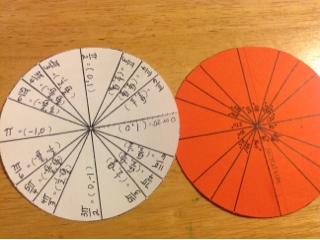
1. Trig Wheel of Values
A colleague gave me this a few years back and I think it's a lot of fun. It's a great way to turn a degrees angle into radians and review its ordered pair. And it's cute!
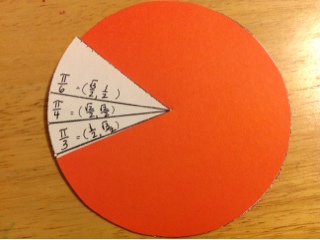
You start with two circles (one with degrees, one with radians and ordered pairs). When you assemble correctly you can see an easy conversion from one to the other. If I happen to get to the store, I usually pick up some of those brass brads to stick through the center to keep the circles together.
2. Today in class we played Around the World (remember playing that in 3rd grade?) with sin/cos/tan values. I let the kids reference their unit circle, but that'll be the last time that happens! I put the cards together on Quizlet, then embedded the deck on Schoology (our online environment). Here's my deck:
3. I'll probably put the Finger Trick for Trig out there for the kids, too. Seen this one?
If you're interested in any of my other random precalc stuff, here's a link to some stuff I put on box.net a couple of years ago. It's not greatly up to date, but it's someplace to start!
I have a few things that I give them to help out a bit.
1. Trig Wheel of Values
A colleague gave me this a few years back and I think it's a lot of fun. It's a great way to turn a degrees angle into radians and review its ordered pair. And it's cute!
You start with two circles (one with degrees, one with radians and ordered pairs). When you assemble correctly you can see an easy conversion from one to the other. If I happen to get to the store, I usually pick up some of those brass brads to stick through the center to keep the circles together. 2. Today in class we played Around the World (remember playing that in 3rd grade?) with sin/cos/tan values. I let the kids reference their unit circle, but that'll be the last time that happens! I put the cards together on Quizlet, then embedded the deck on Schoology (our online environment). Here's my deck:
3. I'll probably put the Finger Trick for Trig out there for the kids, too. Seen this one?
If you're interested in any of my other random precalc stuff, here's a link to some stuff I put on box.net a couple of years ago. It's not greatly up to date, but it's someplace to start!
Thursday, November 8, 2012
Patty Paper FTW
Patty paper rocked my world today.
Last week in Precalculus we finally started talking about radians. After doing the basics (what is a radian/complementary/supplementary/coterminal) and some not-so-fun angular and linear velocity problems, today we got to what will change my students' lives forever.
The Unit Circle.
Several years ago I started giving them an image like this one to fill out instead of the one above. It's so much more organized.
Last week in Precalculus we finally started talking about radians. After doing the basics (what is a radian/complementary/supplementary/coterminal) and some not-so-fun angular and linear velocity problems, today we got to what will change my students' lives forever.
The Unit Circle.
When we create the unit circle in class, I like for them to know where those darned ordered pairs come from. So in the past I would hand out a notecard for each kid and ask them to trace the 30 degree angle to create a 30-60-90 triangle. Once they realized that the hypotenuse of the triangle was the same as the radius of the circle (1), we could find the two legs of the triangle. The problem was that to trace the angle they had to be able to see through the notecard onto the unit circle below. I typically would have kids lined up along the back windows with their papers propped up so they could use the sunlight to help them see. Then we'd cut out the triangles and arrange them on the circle so the kids could see that the sides of the triangle were their paths to the ordered pairs. I thought it worked well (instead of just throwing the ordered pairs at them without any rhyme or reason) but the notecard density and having to cut them out slowed us down.
Then last year, two classes in to creating a unit circle, I thought about using patty paper instead of notecards.
And thus my life was changed forever.
(btw, here's the post where I wrote about it last year. Sorry for double posting on the same topic. It just makes me so happy!)
AND I just found a unit circle song that I'd embedded on my blog almost two years ago. THIS IS WHY YOU NEED TO BLOG, PEOPLE! (If your memory is as bad as mine is, anyway.)
Subscribe to:
Posts (Atom)